The digital twin – a comprehensive virtual image of product and production

We enable the digital twin to be used in production: product data, supplemented by models, operating and process data, provides a comprehensive and dynamic image of a real product. It creates the basis for carrying out retrospective analyses as well as making statements about the future of a product.

By enriching the digital twin with more and more current (measurement) data, a detailed digital image is created that enables even more reliable statements and forecasts. For example, services for tracking products can be developed, usage analyses can be carried out or predictive statements can be made for better and more timely maintenance.

Industry and research - ready for use with the digital twin in production

Fraunhofer IPT is working on numerous projects to further develop the digital twin in production and make it usable for a variety of products and tasks in different industries.

We not only support companies in identifying the right tools and suitable sensor technology for data collection: With powerful methodology, suitable analysis tools, our technological expertise and our own high-performance IT and production infrastructure, we enable you to collect, secure, process and analyze huge amounts of data and prepare it to derive suitable measures.

From knowledge to benefits: Digitaler Zwilling.NRW competence center

With the DigitalerZwilling.NRW competence center, the Fraunhofer IPT is building a state-of-the-art infrastructure together with four research partners and nine associated partners from industry, business and educational institutions: The aim is to offer companies, research institutions and schools simple, interactive access to digital twin technology and to make the technology tangible. From the beginning of 2028, inquisitive minds will be able to discover the benefits of this technology for themselves at learning stations using digital twins of real components and production processes as well as in application-related scenarios and simulations. Understanding this will form the basis for their own innovative solutions.
Digital twins in the application

Fraunhofer IPT has already designed and implemented complete digital twins for a wide range of applications in various industries for the purpose of production optimization - not only for different products, but also for entire plants and even buildings.

Green Digital Twins create transparency and savings potential in production

Green Digital Twins help companies evaluate their manufacturing processes from an environmental perspective and optimize them in a targeted manner.

The Digital Twin digitally maps products and links them to manufacturing technologies, process parameters, and environmental indicators. This enables companies to precisely calculate and transparently visualize the carbon footprint of their products.

By analyzing the entire process chain, companies can identify specific emission drivers and obtain concrete levers for reducing CO₂ emissions and resource consumption. This not only increases ecological efficiency, but also economic competitiveness.

In the "BIZ4GREEN" project, we focus on flexibility: Our goal is to be able to transfer the digital twin developed in the project to other products and industries.

Applications in aviation: The digital twin for rotor and stator components saves development time and production costs

© Fraunhofer IPT

We are working on various solutions for production processes in turbomachinery manufacturing that can reduce or even completely avoid costly manufacturing errors:

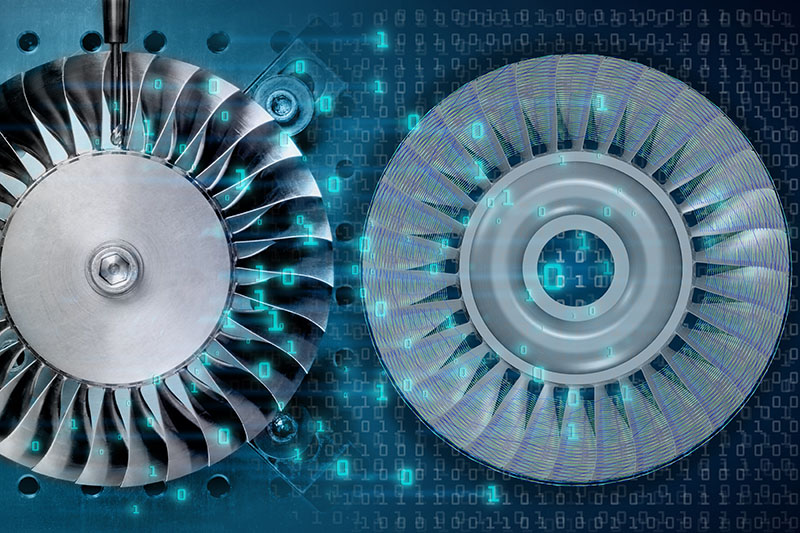
The data collected from the design and development of the complex engine components serves as the basis for the virtual image. All production and sensor data is stored individually for the respective product in the digital twin, so that it carries the complete production history including project and order data.

The extended models with product, production and usage data are available for analysis and accelerate process development and optimization in individual and series production.

In the event of maintenance work, the current status of the component can also be recorded and analyzed using the data stored in the virtual model.

If you have any questions about the digital twin of engine components, please contact Viktor Rudel.

The digital twin enables efficient process design in glass forming

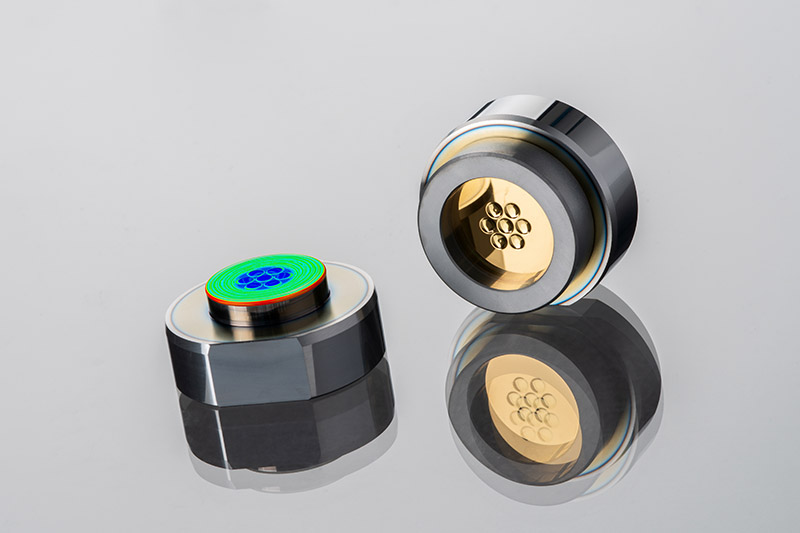
Wafermolds und Simulation einer Linse
© Fraunhofer IPT

Glass forming is an established, efficient manufacturing process for the replicative production of complex-shaped glass optics. During the production process, however, thermal and material influences often lead to a non-tolerable shape deviation of the glass components.

To avoid this shape deviation, Fraunhofer IPT has developed a numerical simulation tool for glass forming. Using the simulation, geometric deviations such as glass shrinkage and optical changes such as the "index drop" can be predicted for the first time and it is possible to realistically map the design of the mold inserts and process control in advance of production. In this way, the use of the simulation tool can significantly reduce product development costs.

Comprehensive models for predicting the forming result

In order to take all relevant influencing factors of the process into account in the simulation, Fraunhofer IPT is carrying out fundamental work to develop a comprehensive process model.  This includes the implementation of a viscoelastic deformation and material model as well as a thermal model that describes the non-uniform temperature distribution within the glass and the tool. Based on extensive test series, Fraunhofer IPT has precise knowledge of the material properties of optical glasses and the corresponding tool materials.

If you have any questions about the digital twin in glass forming, please contact Cornelia Rojacher.

The digital product twin improves battery cell production processes

© deepagopi2011/stock.adobe.com

Digital product twins in battery cell production enable structured consolidation and management of data, information and models that are assigned to a specific instance of a physical intermediate or end product, for example an electrode roll or a battery cell. Descriptive and technical product data is merged in a global data structure and semantically linked. This allows the structure and configuration of the product to be digitally mapped and enriched and linked with data on external environmental influences and relevant process data. Examples include machine parameters from individual processes such as target values for the calender gap or sensor values that are recorded during individual production steps.

The digital product twin makes it possible to create a virtual representation of the products that evolves dynamically across the entire battery cell production process chain. In this way, all information on materials, framework conditions and production steps of the product can be tracked in detail. The findings from this not only support effective quality assurance, but also allow systematic feedback of product quality features with specific production parameters. In this way, potential improvements to products and processes can be identified and product quality can be continuously improved. The digital product twins make it possible to view the properties of all intermediate products involved as well as process data from upstream production steps in much greater detail than before. Only through this linking is it possible to influence the production environment in a context-sensitive manner.

A special feature of the digital product twin is the large number and variety of intermediate products that have to be referenced with each other. These include the electrode pastes and the electrode roll for the anode and cathode, which are combined in the digital twin of the battery.

From the digital representation to the real fiber composite component

The use of digital strategies to predict product quality does not stop at semi-finished products made from fiber composite materials. In order to make the machining processes of thermoplastic and thermoset materials more efficient and sustainable, it is necessary to record and evaluate production data and define optimum target parameters. The digital image can be used for this task.

For the production of pressure tanks made of fibre composites, we use the digital shadow to optimize the production process along the component and ensure component quality.

In thermoplastic tape laying, constant process conditions such as uniform temperature distribution must be present for optimum production results so that residual stresses in the component are kept to a minimum. The digital image can be used to derive optimized taping strategies for homogenizing the temperature. This ensures that the thermoplastic tapes are processed into components of the highest quality.

If you have any questions about the use of a digital twin in fiber composite technology, please contact Henning Janssen.

The digital plant twin provides information about production processes and enables predictive maintenance

Factory on Tablet - Enhanced with Generative AI
© Bipul Kumar/stock.adobe.com

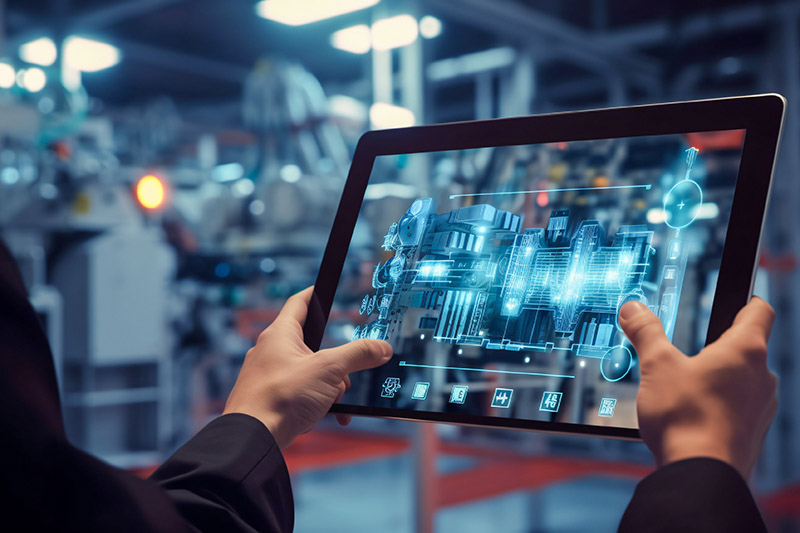
One area of application for the digital twin is in the representation of machines and systems in production. One example of this is the presentation of information and data in a dashboard that serves as a human interaction point. During a process, the data is recorded directly in the machine and merged in a time series database.

In addition, 3D models of the machine can be rendered or pre-rendered for use. This information and data visualizes the current status of the equipment, which can be read on the PLC HMI of the machine itself or standing in front of the machine. By using additional information about the equipment and the machine process, key figures about the machine performance and the stability of the machine process can be calculated. In this way, a range of different data from different sources can be used in targeted data processing steps to create a helpful summarized display for users in production.

This simple form and implementation of the digital twin already allows essential live conclusions to be drawn about the physical object, so that process parameters - which are still largely manual today - can be adjusted. Further use cases that build on this application scenario are already part of predictive and prescriptive analytics, such as the predictive maintenance of wearing parts or fully automated, adaptive process control.

Uniform exchange across all phases of planning, construction and operation of factory buildings

Futuristic Digitalization of Buildings Construction. Architectural Engineer Uses Virtual Reality Software Creating and Developing Commercial House. Future of Real Estate Development
© Gorodenkoff/stock.adobe.com

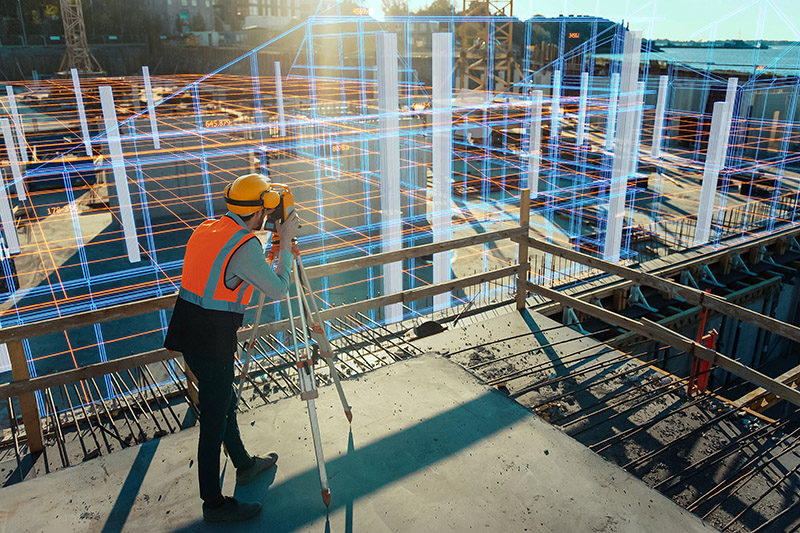
The digital building twin maps the information that is important for the construction of a factory building: In addition to sensors and IT systems, the data basis includes plans, models, drawings, material and supplier data, environmental and sensor data as well as field and user data. The two biggest challenges here are the high number of different stakeholders in construction operations and the heterogeneity of the available data sources. Unified exchange platforms can create synergies and provide uniform access points and standards for processing information.

The digital twin can provide various services for the user: For example, construction progress can be continuously monitored during the construction phase of a project. In addition, virtual inspections offer high added value for the project partners at an early stage. The optimization of planning statuses and the automatic adjustment of factory layouts and material flows also help to better organize real construction activities.

The factory twin not only offers added value through a better exchange of information right from the planning stage, but also through virtual inspections during the construction phase. Operators also benefit during the use of the building through a variety of options for holistic optimization of the environmental parameters of their production, for example through automated conditioning of clean and dry rooms.

The benefits of the digital twin for the manufacturing industry

Better control, monitoring and optimization of products and processes: By using all product-related data and with the help of predictive simulations, companies increase their production efficiency and product quality, while reducing manufacturing and service costs and creating capacities to prepare for the challenges of the future.

Product development

The digital twin of a product can be used for virtual tests and simulations in order to optimize the design, make performance predictions and detect product defects at an early stage. This reduces development costs and time-to-market.

Maintenance and servicing

The digital twin provides information about the condition and performance of a product in real time: data analyses can be used to detect anomalies or wear and tear and initiate maintenance. This reduces downtimes, extends the service life of products and increases their efficiency.

Process optimization

Another field of application for digital twins is the optimization of production and business processes: By analyzing production data, bottlenecks can be identified, processes improved and efficiency increases achieved. This reduces costs and increases productivity.

Virtual commissioning

With a digital twin, systems and production lines can be tested and optimized virtually before they are physically set up in reality. In this way, weak points and bottlenecks can be identified and eliminated at an early stage, saving time and costs.

Education and training

Digital twins can also be used for training courses. Employees learn to master complex tasks in a virtual environment or can practise certain scenarios. This reduces training costs and increases the effectiveness of training courses.

  • A digital twin enables better control, monitoring and optimization of products and processes through the use of comprehensive data and simulations. This enables companies to increase efficiency and quality, reduce costs and create sustainable structures.

  • A digital twin enables better control, monitoring and optimization of products and processes through the use of comprehensive data and simulations. This enables companies to increase efficiency and quality, reduce costs and create sustainable structures.

    In concrete terms, the benefits can be seen in several fields of application:

    • Product development: virtual tests and simulations help to improve designs, detect errors at an early stage and shorten time-to-market.
    • Maintenance and servicing: real-time data enables predictive maintenance. This reduces downtimes and extends the service life of products.
    • Process optimization: Bottlenecks can be identified, processes improved, and productivity increased by analysing production data.
    • Virtual commissioning: systems and processes are tested digitally before physical installation to identify weak points at an early stage and save costs and time.
    • Education and training: Employees practise complex scenarios in a secure, virtual environment, improving efficiency and reducing training costs.

    Overall, the digital twin is an important tool for the digital transformation of manufacturing companies and ensures the long-term competitiveness of the industry.